
Portland Development Site Sale: 30,000 SF on SE 82nd Avenue
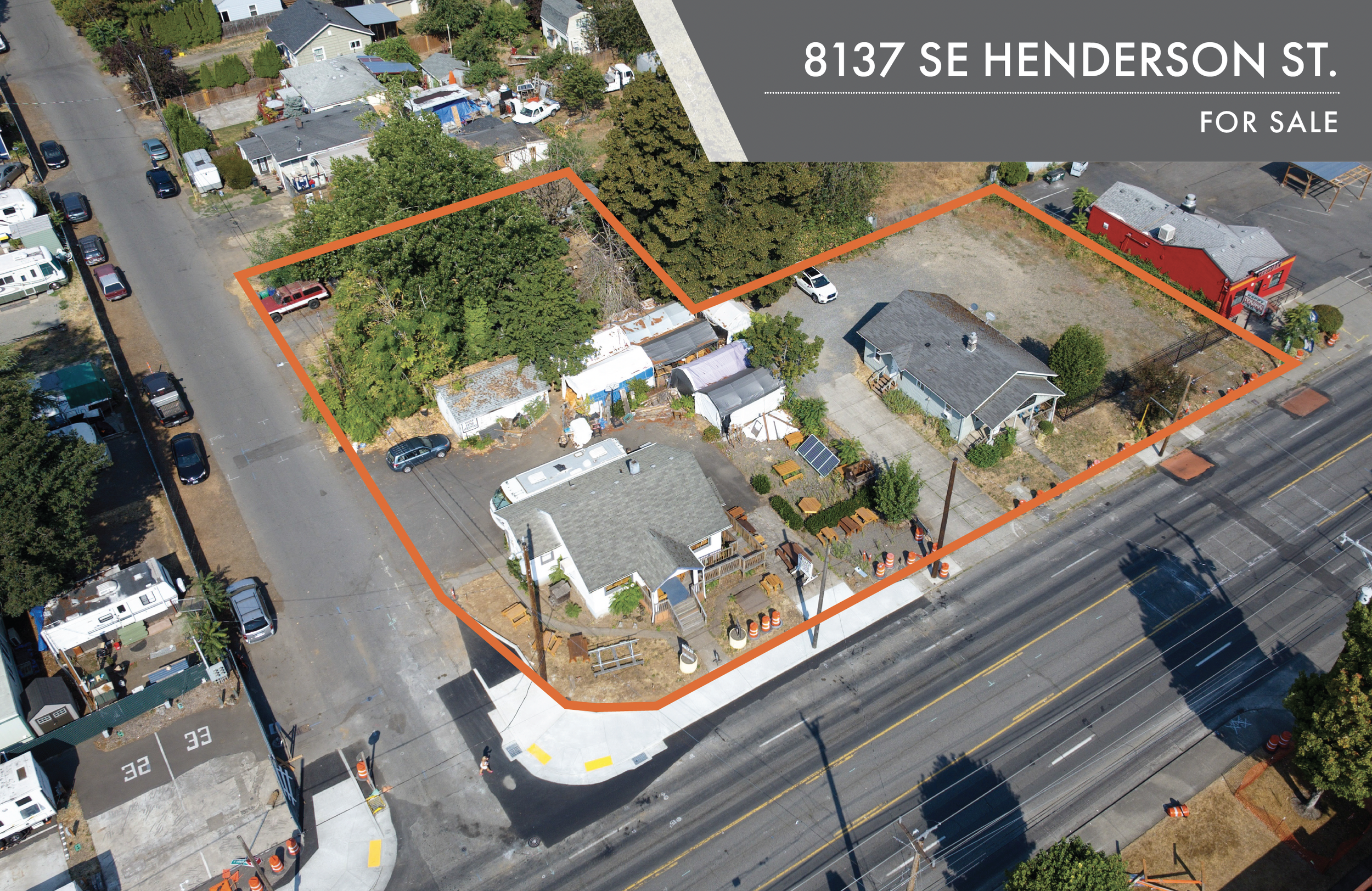
A 30,484 SF development site on Portland’s SE 82nd Avenue corridor just traded at $850,000 — 43 percent below its $1,495,000 asking price. The parcel at 8137 SE Henderson Street sits on five tax lots with 190 feet of frontage along one of Portland’s highest-traffic corridors, and three existing buildings in advanced disrepair made this a tear-down-and-rebuild play from the start.
This case study breaks down the deal structure, due diligence process, and pricing dynamics that shaped the outcome. Whether you are evaluating Portland development sites or looking to acquire a redevelopment parcel, the transaction illustrates how corridor-level investment trends, property condition, and deal structure interact in the current market.
Portland SE 82nd Avenue Development Site Sale FAQ
Q: How much did the SE 82nd Avenue development site sell for in Portland?
A: The 30,484 SF site at 8137 SE Henderson Street sold for $850,000 — 43% below the $1,495,000 asking price — with an additional $65,000 seller credit at closing, bringing the effective acquisition cost to approximately $785,000.
Q: What zoning does the SE 82nd Avenue development site have?
A: The property is zoned EG1 (General Employment 1) in Multnomah County. EG1 zoning allows a wide range of office, light industrial, creative services, manufacturing, and distribution uses — making it one of Portland’s most flexible commercial zoning designations for redevelopment.
Q: Why did the Portland development site sell below asking price?
A: Three factors drove the discount: all three existing buildings required renovation so extensive the inspection report recommended weighing demolition versus repair, the buyer waived financing to pay cash, and the property had been listed since August 2024. A $65,000 seller credit for inspection-related items further reduced the effective price.
Q: What is the 82nd Avenue TIF District in Portland?
A: Portland City Council approved the 82nd Avenue Tax Increment Finance district in October 2024, allocating an estimated $460 million over 30 years for affordable housing, economic development, and infrastructure along the corridor. Combined with a $185 million infrastructure investment and the Civic Corridor designation, SE 82nd Avenue is positioned for significant long-term transformation.
SE 82nd Avenue Development Site Overview Portland
The property at 8137 SE Henderson Street occupies the northwest corner of SE 82nd Avenue and SE Henderson Street in the Lents neighborhood of outer Southeast Portland. Key property characteristics that shaped both the listing and eventual sale:
The site spans 30,484 square feet across five contiguous tax lots (Lots 12 through 16, Block 6, Sterling plat). It delivers 190 feet of frontage along SE 82nd Avenue, one of Portland's busiest arterials. Traffic counts near the property reach approximately 8,900 vehicles per day at Henderson, with the broader 82nd Avenue corridor exceeding 40,000 vehicles daily.
Zoned EG1 (General Employment 1), the site allows office, light industrial, creative services, manufacturing, distribution, and limited retail uses. For a buyer seeking a Portland industrial or mixed-use redevelopment opportunity, EG1 zoning provides meaningful flexibility to match the end use to market demand rather than being locked into a single product type.
The seller, a Nevada-based LLC, had held the property since at least 2005. Three structures occupy the site — addressed as 7303 SE 82nd Ave, 7315 SE 82nd Ave, and 8137 SE Henderson Street — but none were in functional condition at the time of sale.
Portland Development Site Due Diligence and Inspection
Due diligence drove this deal's trajectory more than any other factor. The buyer commissioned a comprehensive property inspection that ran over 230 pages and evaluated all three buildings across foundation, framing, exterior, roofing, electrical, plumbing, HVAC, and interior systems.
The conclusion was unambiguous: every major building system required significant repair, and the inspector recommended that the buyer weigh renovation costs against demolition and new construction. This finding fundamentally shaped the negotiation.
For any buyer evaluating a Portland redevelopment site, the inspection report essentially confirmed that the land value — not the building value — was what mattered. That distinction is critical when underwriting development sites with existing improvements. The structures were liabilities, not assets, and the deal needed to be priced accordingly.
Title came back clean through Ticor Title in Portland. A temporary construction easement granted to the City of Portland had already expired, no open deeds of trust were disclosed, and no city liens were found. Clean title on a multi-lot development parcel is never a given, and this simplified closing materially.
Deal Structure and Price Negotiation Portland Oregon
The original letter of intent led to a Purchase and Sale Agreement executed in early April 2026 at $850,000 — already a 43 percent reduction from the $1,495,000 list price set when the property came to market in August 2024.
Several structural elements defined the deal:
The buyer posted $20,000 in earnest money, initially as a promissory note and later funded as a non-refundable cash deposit. Earnest money became non-refundable upon execution of the post-inspection addendum, a meaningful signal of buyer commitment in exchange for the seller's price and credit concessions.
A $65,000 seller credit was negotiated to address the inspection findings. The credit was applied at closing through escrow and settled all inspection-related claims. The seller also agreed to a pre-closing debris cleanup — removing loose trash, discarded items, and stored personal property from the buildings and lot — at the seller's sole expense.
The buyer waived both the general conditions and financing contingencies, converting this to a cash purchase. Waiving contingencies strengthened the buyer's negotiating position and gave the seller certainty of close — a trade-off that contributed to the seller accepting a substantial credit.
The transaction was brokered as a disclosed limited agency, with one broker representing both sides. This structure requires transparency with all parties and can streamline negotiations when both sides understand the process and have independent counsel.
Closing Timeline and Extension Structure Portland
From mutual execution in April 2026, the original closing date was set for July 1, 2026. The agreement included a structured extension framework that gave the buyer up to three sequential 20-day extensions, each requiring a $5,000 non-refundable deposit applied to the purchase price at closing.
The buyer exercised the first extension in late June, moving the deadline to July 21, 2026 and depositing an additional $5,000 in earnest money. The deal ultimately closed on July 15, 2026 — ahead of the extended deadline. The extension deposits are worth noting as a deal structure tool: they give the buyer time flexibility without requiring a price renegotiation, while compensating the seller for carrying the property off-market longer. Each extension deposit was non-refundable and credited toward the purchase price — a structure that kept both sides aligned on reaching the closing table.
For buyer representation clients evaluating complex acquisitions, extension options are one of the most effective mechanisms for managing timeline risk without sacrificing deal position.
82nd Avenue Corridor Investment Outlook Portland 2026
The SE 82nd Avenue corridor is undergoing a structural transformation that makes development site acquisitions along this stretch particularly worth watching.
Portland City Council approved six new Tax Increment Finance districts in October 2024, including one covering the 82nd Avenue corridor. The 82nd Avenue TIF District encompasses 1,868 acres and is projected to generate an estimated $460 million in resources over its 30-year lifespan. That allocation breaks down to roughly $191 million for affordable housing, $191 million for economic and urban development — including commercial property acquisition, renovation, and small business support — and $43 million for infrastructure.
The corridor also benefits from a $185 million infrastructure investment tied to PBOT's assumption of 82nd Avenue from ODOT in 2022. Under the 2035 Comprehensive Plan, SE 82nd Avenue is classified as a Civic Corridor — a designation that prioritizes mixed-use development, enhanced transit, and pedestrian infrastructure.
For investors and developers evaluating Portland redevelopment sites, the 82nd Avenue corridor combines public infrastructure investment, TIF-backed economic development tools, high traffic counts, and EG1 zoning flexibility. Properties that transact today at land-value pricing — like this $850,000 acquisition — are positioned to benefit from corridor improvements that are already funded and in progress.
Portland Development Site Acquisition Strategy
This transaction illustrates several principles that apply to any Portland development site purchase:
Inspection findings drive pricing on redevelopment sites. When existing improvements are liabilities rather than assets, the negotiation shifts to land value. Having a thorough inspection report — even when demolition is likely — creates objective leverage for seller representation discussions and price adjustments.
Cash positions create negotiating power. Waiving financing contingencies removed the most common source of deal failure and gave this buyer room to negotiate a $65,000 seller credit and a below-market price. For buyers who can close with cash or hard money, the total acquisition cost often ends up lower than a financed purchase at a higher face price.
Extension structures protect both sides. The tiered extension framework — each requiring a non-refundable deposit that applied to the purchase price — gave the buyer flexibility while keeping the seller compensated for time off-market. A broker opinion of value before entering negotiations helps both parties understand what the land is worth independent of the improvements.
Corridor-level trends matter more than the parcel in isolation. SE 82nd Avenue's TIF district, infrastructure spending, and Civic Corridor designation create a tailwind that a single property's current condition does not reflect. Development sites in corridors with committed public investment tend to appreciate faster than comparable parcels without those catalysts.
Whether you are evaluating a Portland commercial property for redevelopment or looking to sell an underperforming asset, getting the deal structure right determines whether the transaction closes — and at what price.
Need help evaluating a Portland development site or positioning a property for sale? Start with a broker opinion of value to understand where the market is today and how deal structure can work in your favor.