
Office Lease Renewal and Expansion at Peterkort Centre II, Portland
When a growing company has occupied the same building for more than a decade, a lease renewal is rarely just a renewal. It becomes a negotiation about growth, flexibility, and whether the building still fits — or whether it is time to leave.
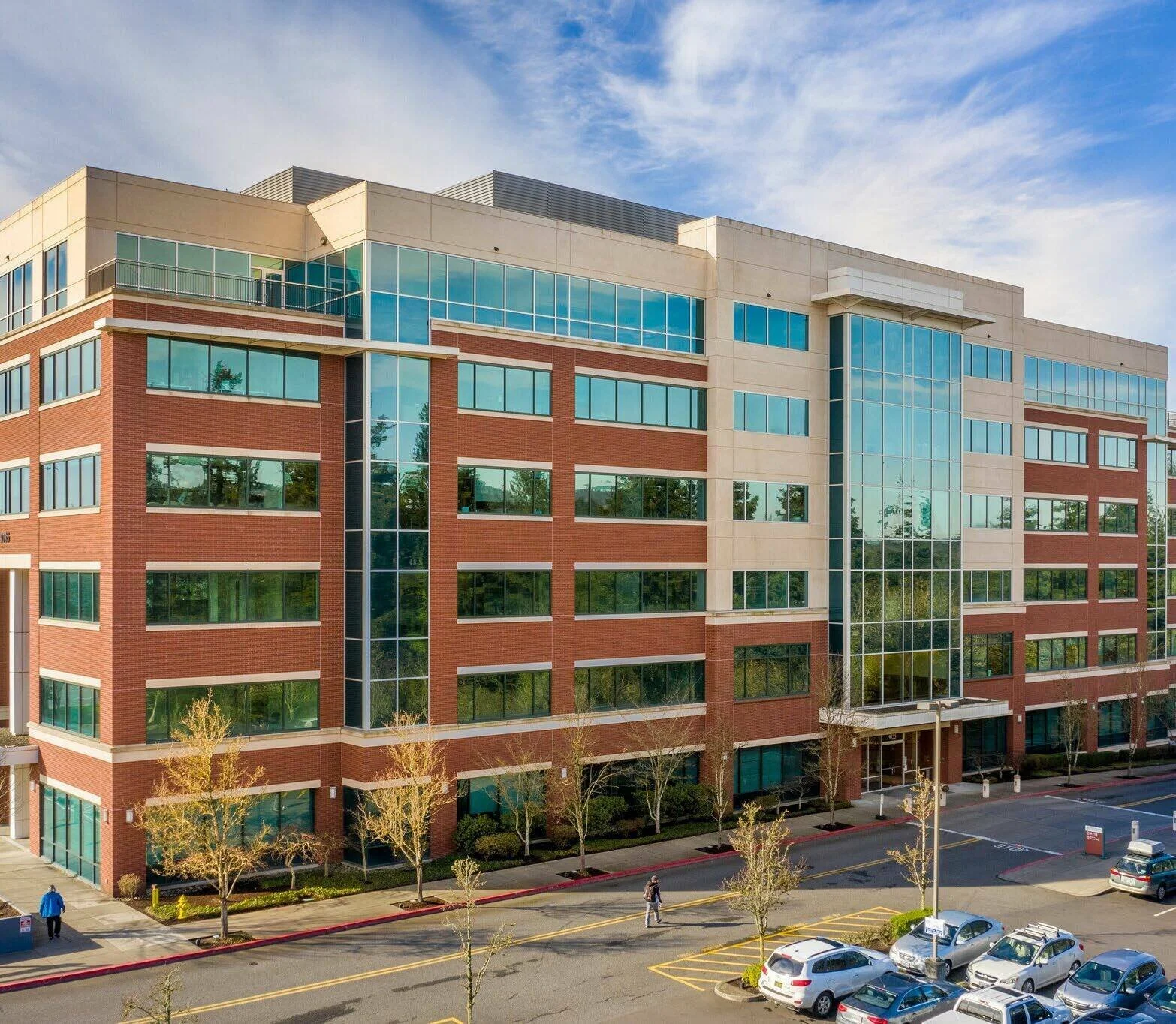
This case study covers a 17,530 SF office lease renewal and expansion at Peterkort Centre II, a Class A suburban office building at 9755 SW Barnes Road in Portland's 217 Corridor. The tenant, a national real estate brokerage franchise with more than 100 agents, had been in the building since 2006 and had outgrown its original footprint three times over. Matt Lyman of Norris & Stevens provided tenant representation throughout the transaction, which included a four-month negotiation, a parallel purchase analysis on a competing building, and more than $200,000 in combined concessions.
Office Lease Renewal FAQ — Peterkort Centre II Portland
Q: What was the final lease size at Peterkort Centre II?
A: The tenant renewed 12,739 RSF of existing space and expanded by 4,791 RSF on the fifth floor, bringing the total to 17,530 RSF under a 62-month term.
Q: How much did tenant representation save in this Portland office lease renewal?
A: The negotiation secured a starting rate of $26.25/SF (down from the landlord's initial ask of $27.00/SF), plus three months of free rent on the expansion, half-rent abatement on the existing space, and more than $200,000 in tenant improvement allowances — including rollover credits from a prior amendment.
Q: What is the 217 Corridor office submarket in Portland?
A: The 217 Corridor includes Beaverton, Tigard, and the surrounding area along Highway 217. It offers suburban office space with a Portland mailing address while avoiding Multnomah County's business income tax — a meaningful cost advantage for companies with significant revenue.
Q: Why did the tenant consider buying a building instead of renewing?
A: The tenant evaluated purchasing a 63,027 SF Class A office building in Beaverton for $6.6 million. A detailed lease vs. own analysis showed that renewal made more financial sense given the capital requirements and risk profile — but the purchase option created genuine leverage in the lease negotiation.
Tenant Growth at Peterkort Centre II — 5,000 to 17,530 SF in Portland
The tenant first occupied Peterkort Centre II in 2006 with roughly 5,000 SF. Over the next 11 years, the company signed five lease amendments as its Portland operation grew. The second and third amendments added space on the fifth floor, expanding the footprint to approximately 9,037 RSF. The fourth amendment in 2015 brought on Suite 160 on the first floor, pushing the total to 16,441 RSF.
By 2017, the split-floor configuration had become inefficient. The first-floor suite was disconnected from the main operation upstairs, and the company needed additional contiguous space on the fifth floor to accommodate new agents and support staff. The fifth amendment — the transaction covered here — consolidated the operation: the tenant gave up the 3,702 RSF first-floor suite and took a 4,791 RSF expansion suite on the fifth floor, producing a net gain of roughly 1,089 RSF and a far better layout.
This kind of organic growth within a single building is common for professional services firms in suburban Portland. When it works, it avoids the cost and disruption of relocation. But it only works if the lease renewal strategy keeps pace with the company's space needs and the landlord is willing to negotiate flexible terms at each stage.
Office Lease Renewal Negotiation Strategy in Portland's 217 Corridor
The negotiation ran from February through May 2017, with three rounds of proposals and counter-proposals before the parties reached agreement. The lease was executed in November 2017 with a commencement date of November 1.
The process started with a formal request for proposal sent to the landlord's broker at Capacity Commercial Group. The RFP outlined two options: a renewal of the existing 12,739 SF plus a 4,971 SF expansion, and a larger scenario that also renewed the first-floor suite. It requested a five-year term, a tenant improvement allowance, two renewal options, early occupancy, and no relocation clause.
The landlord responded with an initial rate of $27.00/SF with 3% annual escalations and two months of free rent on the expansion space. The counter-proposal pushed back on several fronts: a lower starting rate of $25.00/SF, reduced escalations at 2.5%, five months of free rent on the expansion, three months of free rent on the existing space, and rollover of unused tenant improvement credits from the fourth amendment.
Over the next two months, the parties exchanged two more rounds of proposals. Each iteration narrowed the gap on rate, concessions, and TI terms. The letter of intent stage moved quickly once the economic terms were settled, and the lease amendment was fully executed within six months of the final counter-proposal.
A key factor in the tenant's lease negotiation leverage was the parallel analysis of a purchase alternative — covered in the next section.
Lease vs. Own Analysis: Evaluating a Portland Office Purchase
While negotiating the renewal at Peterkort Centre II, the tenant simultaneously evaluated purchasing a 63,027 SF Class A office building at 11000 SW Stratus Street in Beaverton — Creekside IV, a three-story building in the Sunset Corridor built in 1985 and renovated in 2010.
The purchase would have been a significant shift. Instead of leasing 17,530 SF, the tenant would own an entire 63,027 SF building with 244 parking spaces, occupy a portion, and lease the remainder to generate income. A letter of intent was submitted at $6.6 million — roughly $104.72/SF — with $60,000 in earnest money, a 60-day due diligence period, and a 90-day financing contingency.
The proforma analysis modeled three pricing scenarios based on comparable sales in the submarket, with per-square-foot values ranging from $93 to $228. NOI projections ranged from $567,000 (without imputing rent for the tenant's own space) to $851,000 (charging market rent across the entire building). Refinance scenarios explored both cash-out and no-cash-out structures.
Ultimately, the buying vs. leasing analysis showed that the capital requirements and management burden of owning a 63,000 SF building outweighed the benefits for this tenant. But the exercise was far from wasted. Having a credible purchase alternative on the table — with a signed LOI and detailed financial modeling — gave the renewal negotiation real teeth. The landlord at Peterkort Centre II knew the tenant had a genuine exit option, which directly contributed to the concessions outlined below.
Key Concessions in the Portland Office Lease Renewal
The final deal reflected meaningful movement from the landlord's original position.
The starting rental rate came in at $26.25/SF full-service, down from the landlord's initial ask of $27.00/SF, with 3% annual escalations over the 62-month term. While the escalation structure matched the landlord's proposal, the lower base compounded into significant savings over five years.
Free rent included three months on the expansion space and half-rent for three months on the existing 12,739 SF — a combined abatement valued at approximately $54,000.
The tenant improvement package was structured in three tiers. The expansion space received $15.00/SF ($71,865) for build-out. The existing space received $6.00/SF ($76,434) designated for carpet and paint. And the tenant recovered $55,620 in unused TI allowance from the fourth amendment — credits that would have been forfeited without negotiation. Total TI across all three tiers exceeded $200,000.
The deal also included a right of first offer on Suite 595, an adjacent 6,970 SF suite on the fifth floor, providing a built-in expansion path. One five-year renewal option was included, and the parking package covered 51 surface spaces (free), 14 covered deck spaces at $50/month, and 5 building spaces at $60/month.
Why Tenant Representation Matters for Portland Office Renewals
This transaction illustrates why tenant representation produces better outcomes in complex lease renewals. A few specific dynamics were at work.
First, the multi-round negotiation required market knowledge and a structured counter-proposal process. Each counter was benchmarked against comparable transactions in the 217 Corridor and broader Portland suburban market. Without comp data, the tenant would have been negotiating blind against a landlord who tracks every lease in the building.
Second, the parallel purchase analysis added a layer of complexity that most tenants would not pursue on their own. Sourcing the Creekside IV opportunity, submitting an LOI, and building a credible proforma all required commercial brokerage resources — but the leverage they created was directly responsible for concessions that exceeded $200,000 in TI and abatement.
Third, the consolidation from a split-floor to a single-floor configuration required negotiating the surrender of one suite and the expansion into another within the same amendment. This is not a standard renewal — it is a restructuring of the tenancy, and the economic terms need to reflect the landlord's benefit of retaining a higher-quality, more committed tenant.
For tenants approaching a renewal in Portland's suburban office market, the takeaway is straightforward: start the process early, engage a broker who will run the full analysis, and make sure the landlord knows you have options.
217 Corridor Beaverton Office Market for Portland Tenants
Peterkort Centre II sits at 9755 SW Barnes Road, just off Highway 217 — one of Portland's most established suburban office submarkets. The area includes Cedar Hills, Sunset Highway corridor access, and proximity to Washington Square, giving tenants a Portland address with suburban accessibility and parking ratios that downtown cannot match.
For this tenant, the 217 Corridor offered two additional advantages. The building's Portland mailing address avoids Multnomah County's business income tax, which applies to businesses earning more than $100,000 in gross receipts within the county. For a real estate brokerage with significant revenue, this represents a material annual savings. The submarket's parking ratios — this lease included 70 total spaces for 17,530 SF, roughly 4.0 per 1,000 SF — also support the kind of high-traffic office environment that agents and clients expect.
Current 217 Corridor office vacancy sits around 18.5%, moderate compared to downtown Portland's 34% but elevated relative to pre-pandemic levels. That environment gives tenants meaningful leverage in renewal negotiations — a dynamic that has only intensified since this deal closed.
Ready to negotiate an office lease renewal in Portland? Whether approaching a renewal, evaluating expansion options, or weighing a lease-vs.-own decision, the right analysis starts with understanding the market. A lease rate analysis and comparable transaction review can establish the baseline — and a tenant rep broker can turn that data into negotiating leverage.