
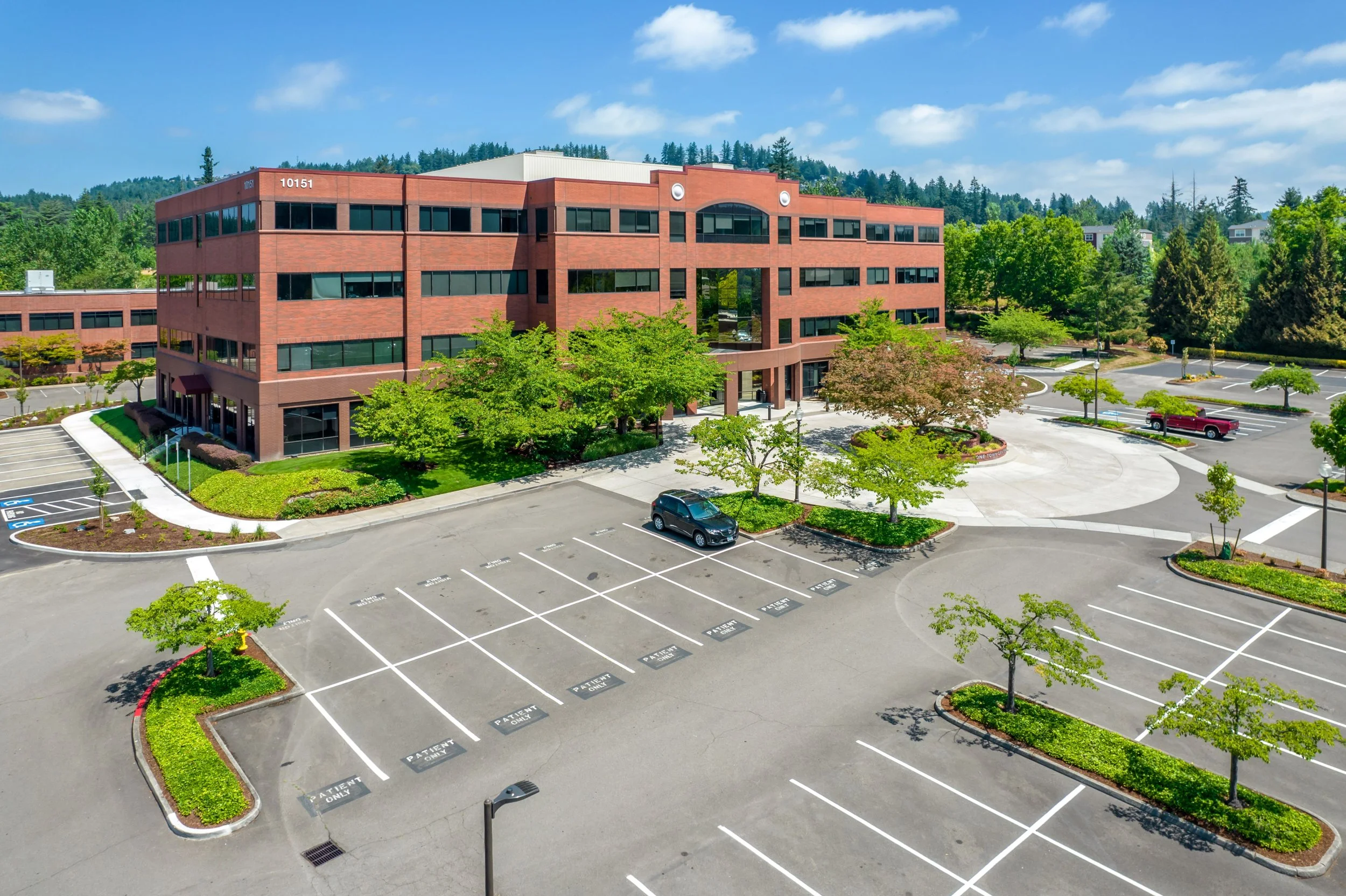
Clackamas & Milwaukie Office
Office leasing guidance for Portland's southeast suburban corridor — building inventory along I-205, McLoughlin Boulevard, and the Orange Line, with comparisons to Gateway, Lake Oswego, and Downtown Portland.
ABOUT CLACKAMAS & MILWAUKIE
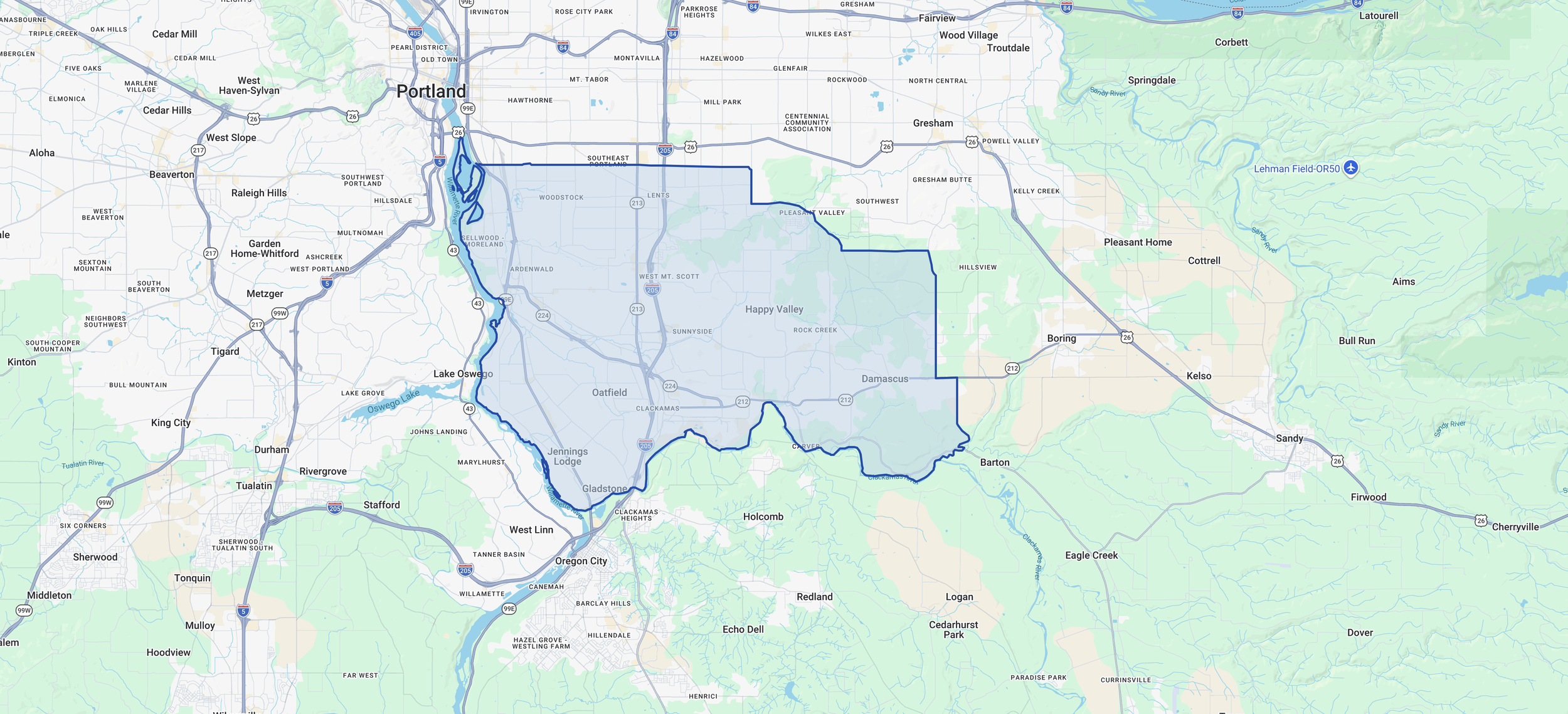
Clackamas and Milwaukie form the southeast leg of Portland's suburban office market — a corridor of low-rise office buildings, medical-professional product, and small commercial centers spread along I-205, McLoughlin Boulevard (Highway 99E), and Highway 224 between the Sellwood Bridge and Oregon City.
There's no single office park or campus anchoring this submarket. Instead, office inventory clusters around a handful of nodes: the Clackamas Town Center area near I-205 and Sunnyside Road, the Milwaukie downtown core along McLoughlin and Harrison Street near the Orange Line terminus, the Johnson Creek Boulevard corridor, and scattered professional office product along Highway 224 toward Milwaukie's industrial edge.
The submarket draws tenants who need affordable space on Portland's east side with highway access and proximity to a workforce that lives in Clackamas, Happy Valley, Oregon City, West Linn, and the Highway 212 corridor. It's not a prestige address — it's a working location for practices and operations that serve southeast Portland and the northern Clackamas County population base.
WHAT’S DIFFERENT ABOUT THIS SUBMARKET
Clackamas and Milwaukie occupy a position that no other Portland submarket replicates: affordable east-side suburban office with direct light rail access and full I-205 interchange connectivity.
The Orange Line — MAX's newest extension — runs from Downtown Portland through Milwaukie with stations at SE Park Avenue, Downtown Milwaukie, and connections south toward Oregon City via bus. This gives Milwaukie something that Tualatin, the 217 Corridor, and most of Clackamas lack entirely: a legitimate transit option that connects to the urban core in under 30 minutes. For tenants who want suburban economics with urban transit access, downtown Milwaukie is the only east-side submarket that delivers both.
Clackamas, by contrast, is fully car-dependent but compensates with superior highway access. The I-205 and Sunnyside Road interchange puts tenants within 15 minutes of the airport, 10 minutes of Happy Valley's growing residential base, and 20 minutes of Downtown Portland — all without touching I-5. Parking is abundant and free across the corridor.
The product itself is predominantly Class B and C — one- and two-story wood-frame and masonry buildings, many built in the 1980s and 1990s as medical-professional offices or general commercial suites. Building lobbies are modest, common areas are basic, and the tenant mix skews heavily toward healthcare, insurance, legal services, and government agencies. Tenants choosing this corridor are buying location and affordability, not building quality or corporate image.
The primary constraint is perception. Clackamas and Milwaukie don't carry the brand recognition of Lake Oswego, the urban energy of Lloyd District, or the corporate identity of Kruse Way. Companies that recruit from inner Portland's west side or need to host clients from Downtown will find this submarket inconvenient to position. It works best when your clients and employees are already east and south.
LOCATION INFORMATION
The Clackamas and Milwaukie office submarket stretches along the I-205 corridor from the Milwaukie Expressway south to the Clackamas Town Center interchange, with secondary inventory along McLoughlin Boulevard, Johnson Creek Boulevard, and Highway 224.
I-205 is the submarket's spine — providing direct access to Portland International Airport (15 minutes), the I-84 corridor, Oregon City, and West Linn. Highway 224 connects east to Milwaukie's industrial areas and the Clackamas River corridor. McLoughlin Boulevard provides a surface arterial alternative running north-south through the heart of the submarket into Sellwood and inner Southeast Portland.
Transit infrastructure centers on the MAX Orange Line, which opened in 2015 and serves downtown Milwaukie with two stations. Bus connections via TriMet lines 29, 33, and 99 provide coverage along McLoughlin and into the Clackamas Town Center area, though frequency outside peak hours is limited.
Parking follows the suburban pattern — surface lots at 4.0–5.5 stalls per 1,000 SF, virtually all free. Tenants relocating from Downtown Portland or Lloyd District structured parking environments eliminate $50–$75/stall/month in parking costs immediately.
Retail amenities are concentrated around Clackamas Town Center — the region's largest enclosed mall — and the adjacent Clackamas Promenade, which provides restaurants, services, and daily convenience retail. Downtown Milwaukie has added local restaurants, coffee shops, and breweries over the past decade as the Orange Line has catalyzed modest mixed-use development along Main Street and McLoughlin.
CLACKAMAS & MILWAUKIE SNAPSHOT
Known For
Affordable east-side suburban office — typically $18–$24/SF FSG for Class B product
MAX Orange Line providing direct light rail to Downtown Portland from Milwaukie in under 30 minutes
Strong I-205 access to the airport, Happy Valley, Oregon City, and the I-84 corridor
Free surface parking at 4.0–5.5 per 1,000 SF across the corridor
Heavy medical-professional and government tenant base providing stable co-tenancy
Typical User Profiles
Medical practices, dental offices, physical therapy clinics, and specialty healthcare providers
Insurance agencies, claims adjusters, and regional operations centers
Legal practices serving Clackamas County courts and the Oregon City courthouse
Government agencies and social services organizations with Clackamas County operations
Accounting and tax preparation firms serving the east-side residential population
Home services, property management, and real estate companies based in the I-205 corridor
Nonprofits and community organizations needing affordable office with transit access
Best Fits
Tenants needing 800–8,000 SF of functional professional office at the metro's lowest east-side rates
Medical and healthcare practices serving Happy Valley, Oregon City, West Linn, and Milwaukie residents
Organizations that value Orange Line transit access without Downtown Portland rent levels
Companies whose employees commute from Clackamas, Happy Valley, Oregon City, Gladstone, or the Highway 212 corridor
Back-office operations and administrative teams that don't need client-facing presentation
Common Constraints
Very limited Class A inventory — almost no institutional-grade office product in the submarket
Aging building stock with deferred maintenance in some McLoughlin Boulevard and Highway 224 properties
No concentrated office district — inventory is scattered and can feel isolated
Limited restaurant and amenity options outside the Clackamas Town Center node and downtown Milwaukie
Perception gap — the submarket lacks name recognition compared to Lake Oswego, Kruse Way, or even Gateway
Few contiguous blocks above 10,000 SF in true office product
RENT, PRICING, AND DEAL TERMS
Typical Deal Terms
Clackamas and Milwaukie office leases are predominantly full-service gross or modified gross. Asking rates for maintained Class B space run $18–$24/SF annually, with the best-finished product near Clackamas Town Center and in newer Milwaukie mixed-use buildings reaching into the mid-$20s. Older medical-professional suites along McLoughlin and Highway 224 price in the mid-to-high teens, though condition varies significantly and operating expense exposure on older properties can narrow the gap.
The rent differential versus comparable east-side submarkets is meaningful. A 5,000 SF tenant paying $22/SF here versus $26/SF in Gateway or $28/SF in Lloyd District saves $20,000–$30,000 annually on base rent alone — and eliminates $15,000–$22,500 in structured parking costs by moving to free surface lots.
Negotiation Levers
TI allowance: $5–$15/SF on 3–5 year terms; landlords in older product will sometimes go higher to avoid extended vacancy on awkward suite configurations
Free rent: 1–3 months available, particularly on spaces vacant 6+ months or in buildings with deferred capital needs
Lease term: 5–7 year terms unlock the best economics — landlords in this corridor prize tenancy stability over maximizing face rent
Operating expenses: In modified gross structures on older buildings, negotiate expense caps or fixed annual escalations to avoid surprise pass-throughs from aging HVAC, roofing, or parking lot repaving
Deal Killers
Corporate or institutional tenants needing Class A finishes, a branded lobby, or conference center amenities
Companies recruiting from Portland's west side, Beaverton, or Hillsboro — the cross-town commute via I-205 or surface streets is a dealbreaker
Requirements above 10,000 SF contiguous that demand modern building systems and efficient floor plates
Comparing Proposals
Normalize parking economics first. If you're comparing a Clackamas option against Gateway or Lloyd District, add $50–$75/stall/month back into any proposal that includes structured parking charges. Then project total occupancy cost over the full lease term — layer in annual escalations, amortize any TI shortfall you'll fund out-of-pocket, and convert free rent into a monthly equivalent discount. In this corridor, the hidden cost isn't in the rent — it's in deferred building maintenance. Walk the HVAC systems, inspect the roof, and ask for three years of operating expense reconciliations before signing. A $19/SF lease in a building facing a $200,000 roof replacement next year is not what it looks like on paper.
Mini Case Example
A 12-person insurance claims operation serving Clackamas County evaluated three options: renewing in a dated suite on McLoughlin Boulevard in Milwaukie at $17/SF, relocating to a better-finished building near Clackamas Town Center at $23/SF, and moving to a Class B+ building in Gateway near the MAX station at $26/SF.
The McLoughlin space had known HVAC issues and the landlord was unwilling to fund any tenant improvements. The Gateway option offered better transit access but added $55/stall/month in structured parking for 15 vehicles — $9,900 annually. After normalizing parking, TI amortization, and projected operating expense escalations, the Clackamas Town Center option came in $14,000/year cheaper than Gateway on total occupancy cost, offered a better commute profile for staff living in Happy Valley and Oregon City, and included a full turnkey buildout on a five-year term. The firm relocated to Clackamas and redirected the savings into a second adjuster hire.
SUBMARKET FAQ
-
Geographically adjacent, but functionally different. Happy Valley's commercial development is retail-driven — Crossroads East, the Town Center retail cluster along Sunnyside Road. There's very little dedicated office product in Happy Valley itself. Most professional tenants serving the Happy Valley population lease office space in Clackamas near the I-205/Sunnyside interchange or along the 82nd Avenue corridor, then commute in from Happy Valley neighborhoods. If Happy Valley ever develops a dedicated office node, it will likely command higher rents than Clackamas due to the residential income demographics.
-
The gap is wider than face rates suggest. Clackamas and Milwaukie Class B space runs $18–$24/SF versus $24–$28/SF in Gateway and $27–$34/SF in Lloyd District. But the real separation is parking — Gateway and Lloyd both have structured parking environments where tenants pay $50–$75/stall/month, while Clackamas and Milwaukie offer free surface parking at generous ratios. For a 5,000 SF tenant with 15 vehicles, that parking differential alone is $9,000–$13,500 annually on top of the base rent savings.
-
It gives downtown Milwaukie a transit advantage no other southeast suburban submarket has. The SE Park Avenue and Downtown Milwaukie stations connect to Portland State, the South Waterfront, and Pioneer Square in 25–30 minutes. For tenants recruiting younger employees who prefer transit or for organizations with regular business Downtown, this is a real differentiator versus Clackamas, Tualatin, or the 217 Corridor — all of which are essentially car-only. The practical caveat: only buildings within walking distance of the two stations benefit. Once you're a mile south on McLoughlin or east on Highway 224, the transit advantage disappears.
-
Healthcare and government are the two anchors. The proximity to Clackamas County government offices, Kaiser Sunnyside Medical Center, and the concentration of medical-dental practices along McLoughlin and Sunnyside Road creates a co-tenancy base heavily weighted toward professional services that serve those institutions. Insurance agencies, legal practices (particularly those with Clackamas County court business), accounting firms, and nonprofits round out the tenant mix. Technology companies and creative firms are rare — they gravitate toward the Central Eastside, Pearl District, or Lloyd District instead.
-
Very few. Most of the corridor's office stock was built between 1975 and 2000. The mixed-use development around the Milwaukie Orange Line stations has added some ground-floor commercial and small office product, but nothing approaching the scale of new construction in the Central Eastside or Lloyd District. Tenants who need modern building systems, energy-efficient envelopes, and contemporary finishes will find limited options — the best-maintained product near Clackamas Town Center is the closest this submarket gets to updated Class B+ space.
-
Six to eight months before lease expiration for spaces under 5,000 SF. Nine to twelve months for larger requirements or specialized buildouts like medical-dental suites that need plumbing and equipment infrastructure. The submarket has lower turnover than Gateway or Lloyd District — spaces are leased for longer terms and the tenant base is sticky — so fewer options hit the market at any given time. Starting early lets you evaluate the limited inventory without being forced into a renewal at whatever your landlord dictates.
WHAT’S YOUR PROPERTY WORTH?
Whether you're benchmarking against recent east-side office sales, evaluating a hold-versus-sell decision on a Clackamas or Milwaukie office asset, or preparing for a refinance conversation with your lender, a broker opinion of value gives you a clear, comp-based pricing range for your property. I'll deliver a comprehensive report covering comparable sales, lease comps, vacancy analytics, and a pricing summary with conservative, probable, and optimistic values — at no cost and no obligation.
ARE YOU PAYING THE RIGHT LEASE RATE?
Whether you're negotiating a new lease along the I-205 corridor, approaching a renewal on McLoughlin Boulevard, or benchmarking your current rate against what comparable tenants are paying near Clackamas Town Center or in downtown Milwaukie, a lease rate analysis gives you the data to negotiate from a position of strength. I'll pull current comps, identify concession packages available in the submarket, and show you where your deal stands relative to the market — so you're not leaving money on the table at renewal.
RELATED
GET IN TOUCH
Choosing the right office space in Clackamas or Milwaukie means weighing trade-offs that aren't obvious from a listing sheet — parking economics versus transit access, building condition versus face rent, and whether the I-205 corridor actually serves your workforce better than Gateway or Lloyd District at a higher price point.
I work with tenants across Portland's southeast suburban market and can help you benchmark options, negotiate deal terms, and avoid the hidden costs that show up in older corridor product. Whether you're starting a new lease search, evaluating a renewal, comparing this submarket against other east-side options, or just want a straight read on what your current deal looks like relative to the market, I'm here to help.