
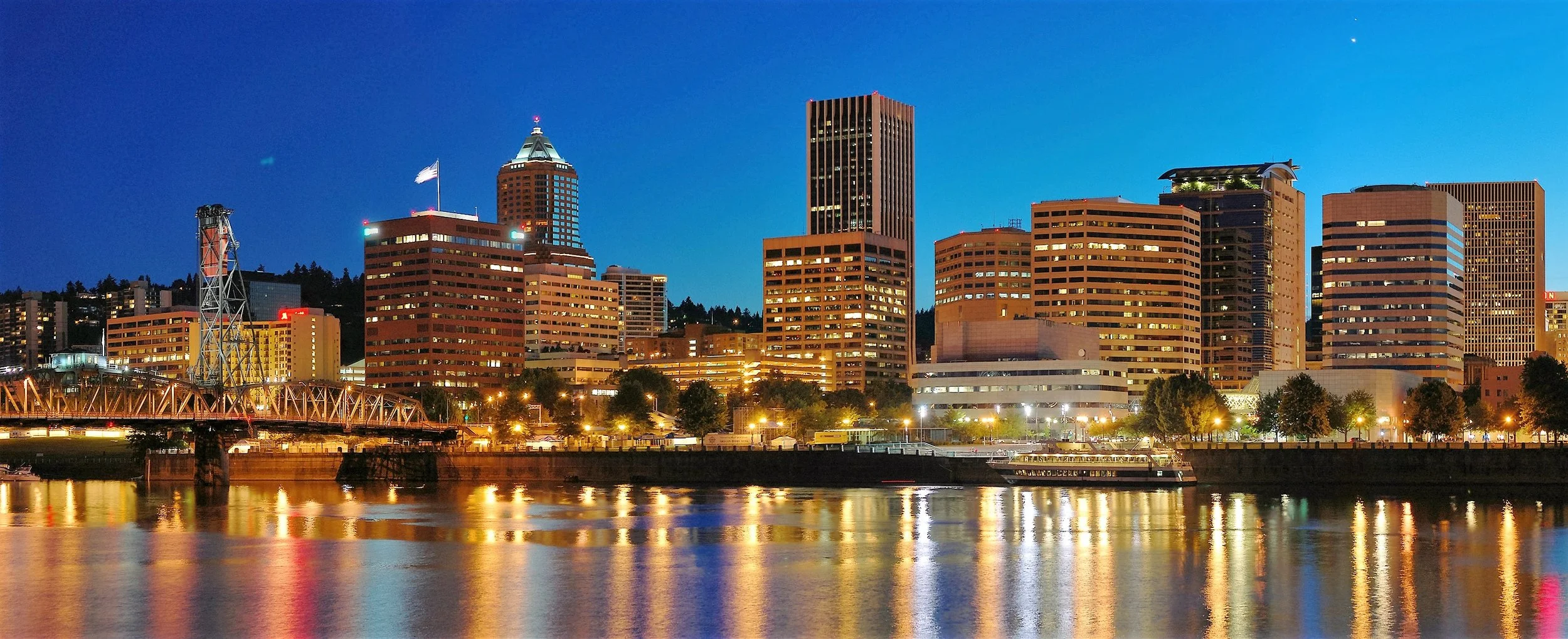
Sunset Corridor & Hillsboro Office
Office leasing guidance for the Sunset Corridor through Hillsboro — tech campus inventory, pricing by node, MAX Blue Line access, and how to evaluate this submarket against the 217 Corridor and Downtown Portland.
ABOUT SUNSET CORRIDOR & HILLSBORO
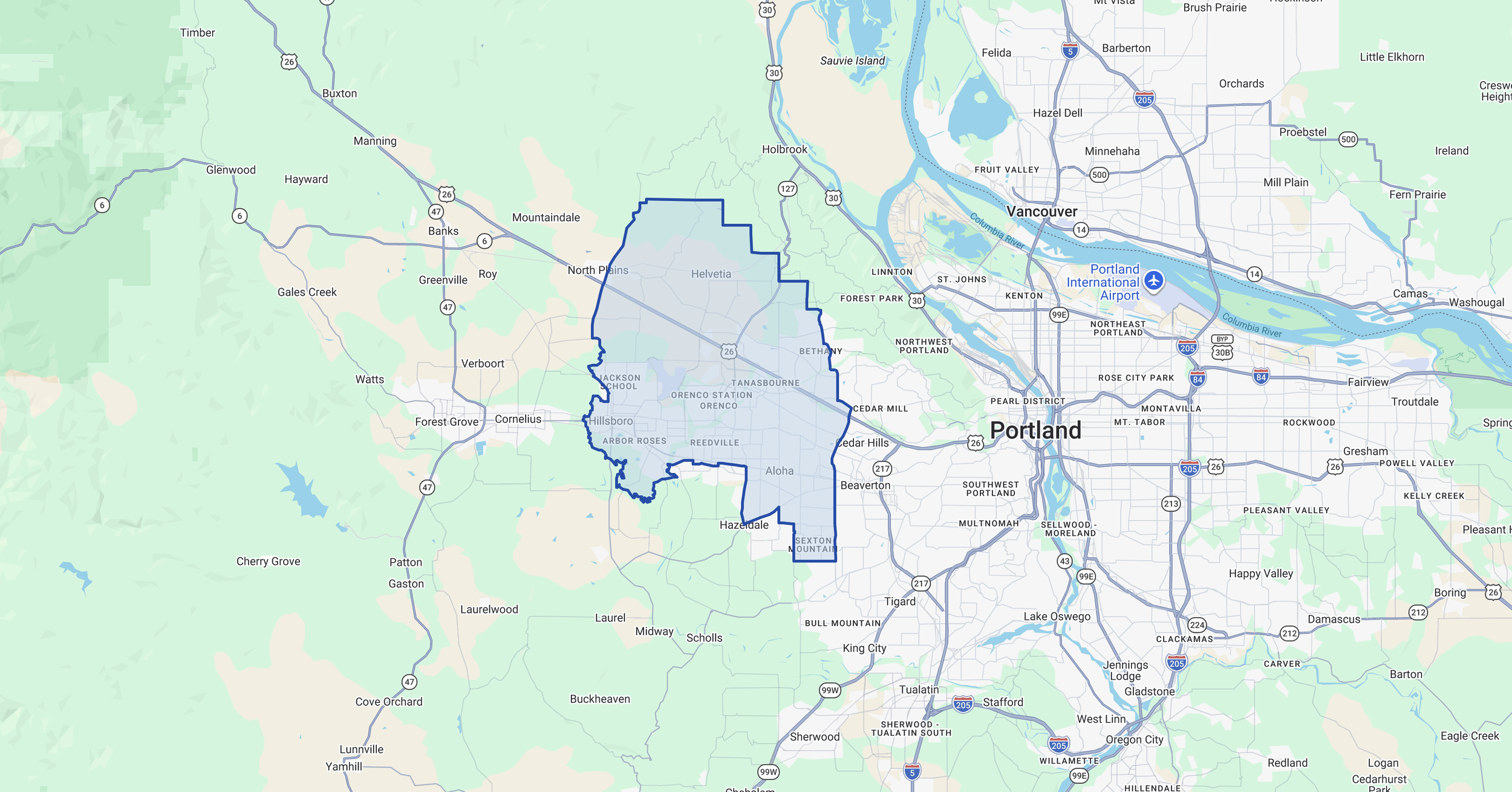
The Sunset Corridor is the Portland metro's technology-driven office submarket — a concentration of campus-style office product running along Highway 26 from the western edge of Beaverton through Hillsboro to the Intel and semiconductor cluster near Cornelius Pass Road. The corridor houses roughly 5 million square feet of office inventory anchored by a handful of major nodes: AmberGlen Corporate Park, the Tanasbourne area near Cornell Road, Orenco Station, and the corporate campuses south of Highway 26 near Jones Farm Parkway.
This submarket exists because of the tech sector. Intel's presence — still the largest private employer in Oregon despite significant layoffs in 2024 and 2025 — shaped the corridor's development pattern and tenant mix. Semiconductor suppliers, EDA software firms, engineering companies, and technology services businesses cluster here because proximity to Intel and the broader silicon ecosystem matters for recruiting, client relationships, and operational efficiency.
But the Sunset Corridor isn't exclusively a tech play. The same campus product that attracts technology firms also serves healthcare systems, insurance companies, financial services operations, and professional services firms whose workforce lives in Washington County. The submarket offers Class A and upper-tier Class B space with parking ratios, building quality, and freeway access that compete with Kruse Way — at price points that often undercut it.
WHAT’S DIFFERENT ABOUT THIS SUBMARKET
The Sunset Corridor's identity is inseparable from its anchor tenants. Intel's ongoing $36 billion investment in its Hillsboro fabrication facilities signals long-term commitment to the area, but the 5,400+ Oregon-based job cuts since August 2024 have released shadow space and sublease inventory into a market already adjusting to post-pandemic rightsizing. The result is a submarket in transition — elevated vacancy in some buildings, aggressive concession packages from landlords competing for tenants, and genuine uncertainty about how much tech-sector demand will recover.
For tenants, this creates a window. Class A campus product that was fully occupied and competitively priced three years ago is now available with concession packages that significantly reduce effective rent. The buildings haven't changed — the leverage has.
The MAX Blue Line is the corridor's other distinguishing asset. It runs the full length of the submarket from Beaverton to Hillsboro, with stations at Orenco, Quatama, Willow Creek, and Fair Complex/Hillsboro Airport. For companies that need suburban campus space with genuine transit access — not a bus route, but rail — the Sunset Corridor is the only Portland suburban submarket that delivers it.
The trade-off is Highway 26. Westbound morning congestion from Portland and eastbound afternoon congestion back toward the city remain the corridor's defining frustration. Employees commuting from inner Portland or the east side face 40–60 minute drives during peak hours. The submarket works best when your workforce already lives in Washington County.
LOCATION INFORMATION
The Sunset Corridor office submarket follows Highway 26 west from approximately the Bethany Boulevard interchange through Hillsboro, with office concentrations clustered at several key nodes. AmberGlen Corporate Park sits just north of Highway 26 near the Willow Creek interchange and represents the corridor's densest multi-tenant office concentration. The Tanasbourne node clusters along Cornell Road and 185th Avenue, blending office with the retail and dining amenities of the Tanasbourne Town Center. Orenco Station, built around the MAX Blue Line stop, offers newer mixed-use development with walkable retail and residential. South of Highway 26, corporate campuses along Jones Farm Parkway and Ronler Acres serve Intel and its supplier ecosystem.
Transportation access centers on Highway 26 (Sunset Highway), which connects directly to Downtown Portland and I-405 to the east and continues west toward the Coast Range. Highway 217 provides north-south connectivity to Beaverton, Tigard, and I-5. The MAX Blue Line runs from Hatfield Government Center in downtown Hillsboro through the corridor's major employment nodes into Downtown Portland.
Parking is suburban-standard — ratios run 3.5–5.0+ stalls per 1,000 SF across most campus product, virtually all surface or structured and included in lease rates. Retail and dining options cluster at Tanasbourne Town Center, Orenco Station, and Streets of Tanasbourne, with additional options along Cornell Road and in downtown Hillsboro.
SUNSET CORRIDOR & HILLSBORO SNAPSHOT
Known For
Portland metro's primary technology and semiconductor office corridor
MAX Blue Line transit access — the only suburban submarket with rail service through its core
Campus-style Class A and upper-tier Class B product with institutional ownership
Elevated concession environment driven by tech-sector rightsizing and sublease availability
Strong parking ratios (3.5–5.0+ per 1,000 SF) included in lease rates
Typical User Profiles
Semiconductor and electronics companies — suppliers, design firms, and EDA software
Technology companies and SaaS firms of all sizes
Engineering, environmental, and technical consulting
Healthcare systems and medical device companies
Insurance carriers and financial services back-office operations
Corporate regional offices and operations centers
Professional services firms serving Washington County clients
Best Fits
Technology companies that need proximity to Intel and the semiconductor supply chain
Tenants seeking 5,000–30,000+ SF of Class A campus space with ample parking and MAX access
Companies whose employees live in Washington County — Hillsboro, Beaverton, Aloha, Forest Grove
Firms relocating from Downtown Portland who want transit access without CBD parking economics
Tenants willing to lock in long-term deals during the current concession window
Common Constraints
Highway 26 congestion during peak commute hours makes inner Portland commutes difficult
Submarket identity is heavily tied to Intel and tech — sector-specific downturns directly affect vacancy and building vitality
Some campus product was purpose-built for single tenants and requires reconfiguration for multi-tenant use
Limited walkability outside Orenco Station and Tanasbourne nodes — most of the corridor is car-dependent between nodes
Sublease inventory from tech companies can create pricing confusion and complicate building-level occupancy assessment
RENT, PRICING, AND DEAL TERMS
Typical Deal Terms
Sunset Corridor office leases are predominantly full-service gross or modified gross with base year expense stops. Asking rates for Class A campus product generally range from $24–$30/SF annually, with well-maintained Class B product in the low-to-mid $20s and AmberGlen value plays occasionally pricing around $19–$20/SF. Effective rates after concessions — particularly in buildings carrying significant vacancy from tech-sector pullbacks — can drop well below asking for creditworthy tenants committing to five-plus-year terms.
The concession environment here is driven by a specific dynamic: landlords absorbed large blocks of space when tech companies downsized, and new tenant demand hasn't kept pace with the inventory returned to market. Buildings with 30%+ vacancy are competing against each other and against sublease options from departing tech tenants. That competition produces TI packages, free rent periods, and rate concessions that weren't available when the corridor was running at 90%+ occupancy.
Negotiation Levers
TI allowance: Elevated in high-vacancy buildings — $25–$45/SF available for creditworthy tenants on longer terms. Lower in tighter buildings where landlords have less pressure
Free rent: 6–12+ months on 5–7 year terms in buildings with significant vacancy; more modest in stabilized product
Sublease leverage: Active sublease listings create pricing benchmarks that put downward pressure on direct deals in the same building or campus
Lease term: Landlords prefer 5–7+ year commitments and will sharpen economics for term length
Escalation structure: Fixed 2.5–3.0% annual bumps are standard; CPI-linked escalations are negotiable in tenant-favorable buildings
Deal Killers
Employees commuting from inner Portland, the east side, or Clackamas County — the Highway 26 commute is a retention risk
Tenants who need walkable street-level amenities throughout the day — outside Orenco and Tanasbourne, the corridor is campus-oriented
Small requirements under 2,000 SF looking for plug-and-play suites — the corridor's product skews toward larger floorplates
Organizations sensitive to building occupancy levels — some campus buildings are running at 50–60% occupied, which affects common area vitality
Comparing Proposals
Evaluate on five-year effective occupancy cost — not asking rate. In the current Sunset Corridor environment, asking rates mask wide dispersion in actual deal economics. A building quoting $28/SF with 12 months free rent and $40/SF TI produces a fundamentally different cost profile than a building quoting $24/SF with 2 months free and $15/SF TI. Model each proposal across the full term: base rent trajectory with escalations, operating expense projections against the base year, TI amortization value, and free rent spread monthly. Parking is a wash within the corridor — it's free everywhere — but normalize against any Downtown or Kruse Way proposals where parking adds $4–$7/SF annually.
When comparing between Sunset Corridor buildings, the critical variable is building occupancy and ownership stability. A well-capitalized institutional owner at 70% occupied will invest in common areas and tenant amenities. A stressed owner at 45% occupied may defer maintenance. Tour buildings at midday to assess actual tenant activity, not just the brochure.
Mini Case Example
A 40-person technology services firm evaluated three options at lease expiration: renewing in a Class B building near Tanasbourne at $22/SF, relocating to a Class A campus at AmberGlen at $27/SF, and moving to a sublease opportunity in a partially vacant campus building along Jones Farm Parkway at $19/SF effective.
The AmberGlen option, despite the highest asking rate, produced the lowest five-year total occupancy cost after factoring in a $40/SF TI allowance, 10 months free rent, and a turnkey delivery that eliminated the firm's out-of-pocket buildout costs. The sublease option was cheapest on paper but offered only 3.5 years remaining on the term and no TI — requiring the firm to fund its own improvements on space it couldn't control long-term. The firm chose AmberGlen, locked in a seven-year term at a blended effective rate below $22/SF, and used the concession package to build out a recruiting-grade office that supported its hiring goals.
SUBMARKET FAQ
-
The 217 Corridor (Beaverton/Tigard) offers a wider range of product types and price points — from mid-teens Class C up to mid-$20s Class A. The Sunset Corridor is narrower in product type (mostly campus Class A and B) but deeper in tech-sector identity and MAX Blue Line access. On a pure cost basis, the 217 Corridor typically offers more affordable options in the Class B segment. But tenants who need campus-quality space with transit access and proximity to the tech cluster will find the Sunset Corridor's current concession environment makes the price gap smaller than it appears on asking rates.
-
Meaningfully. The 5,400+ Oregon job cuts since August 2024 have released sublease space and reduced demand from Intel's supplier and service ecosystem. Vacancy has risen, concessions have expanded, and some buildings that were fully occupied three years ago are now competing aggressively for tenants. For companies leasing today, this is leverage — but tenants should assess whether specific buildings have a credible path to improved occupancy or risk becoming partially empty long-term.
-
For companies recruiting from inner Portland, Beaverton, and along the Blue Line corridor, yes — it's a genuine differentiator. The Sunset Corridor is the only suburban Portland office submarket where employees can take rail transit directly to work. That said, most employees in this corridor still drive. MAX is an advantage for recruiting and commute optionality, not the primary commute mode for the majority of workers.
-
AmberGlen is the corridor's densest multi-tenant office node — mostly Class A and upper B campus product with institutional ownership and the most active leasing market. Tanasbourne offers more variety in building size and quality, better walkable retail access (Tanasbourne Town Center, Streets of Tanasbourne), and a mix of office, medical, and professional services tenants. Orenco Station is the newest node — walkable, mixed-use, and built around the MAX stop — but has less dedicated office inventory. Orenco suits smaller tenants who prioritize transit access and neighborhood walkability over large floorplates.
-
If the remaining term, existing buildout, and floorplan match your needs, sublease can deliver 20–40% below direct asking rates. The risk is limited control — you inherit the buildout, the term is fixed, and you carry counterparty risk if the sublessor has financial issues. For tenants who need space quickly and can work within an existing layout, sublease is a strong play. For tenants who need custom buildout or a term beyond 4–5 years, direct deals with current concession packages may produce comparable economics with more flexibility.
-
Nine to twelve months before lease expiration for spaces under 15,000 SF. Twelve to eighteen months for larger requirements or significant buildouts — construction timelines in campus buildings with high vacancy can be longer due to contractor scheduling and landlord capital approval processes. Even if you plan to renew, run a parallel market search. Landlords in the Sunset Corridor know the competitive landscape and will sharpen renewal terms when they believe you're evaluating alternatives.
WHAT’S YOUR PROPERTY WORTH?
Whether you're benchmarking a Sunset Corridor or Hillsboro office asset against recent sales, evaluating a hold-versus-sell decision on campus product, or preparing for a refinance conversation, a broker opinion of value gives you a clear, comp-based pricing range for your property. I'll deliver a comprehensive report covering comparable sales, lease comps, vacancy analytics, and a pricing summary with conservative, probable, and optimistic values — at no cost and no obligation.
ARE YOU PAYING THE RIGHT LEASE RATE?
Whether you're negotiating a new lease in the Sunset Corridor, approaching a renewal at AmberGlen or Tanasbourne, or benchmarking your current rate against what comparable tenants are paying, a lease rate analysis gives you the data to negotiate from a position of strength. I'll pull current comps, identify concession packages in play, and show you where your deal stands relative to the market — so you're not negotiating blind.
RELATED

GET IN TOUCH
Contact Matt Lyman at Norris & Stevens about leasing, renewing, or evaluating office space in the Sunset Corridor and Hillsboro. Whether you're a tenant comparing the Sunset Corridor against the 217 Corridor or Downtown Portland, a landlord assessing pricing and concession strategy for your building, or an investor evaluating acquisition targets in the submarket, share your situation and Matt will follow up with current market context and a recommended approach.
Include your space requirements — size range, parking needs, building class preferences, budget parameters, and timeline — and Matt will respond with current Sunset Corridor availability, recent lease comps, and clear next steps.