
Johns Landing Office Leasing: 6605 S Macadam Fully Leased
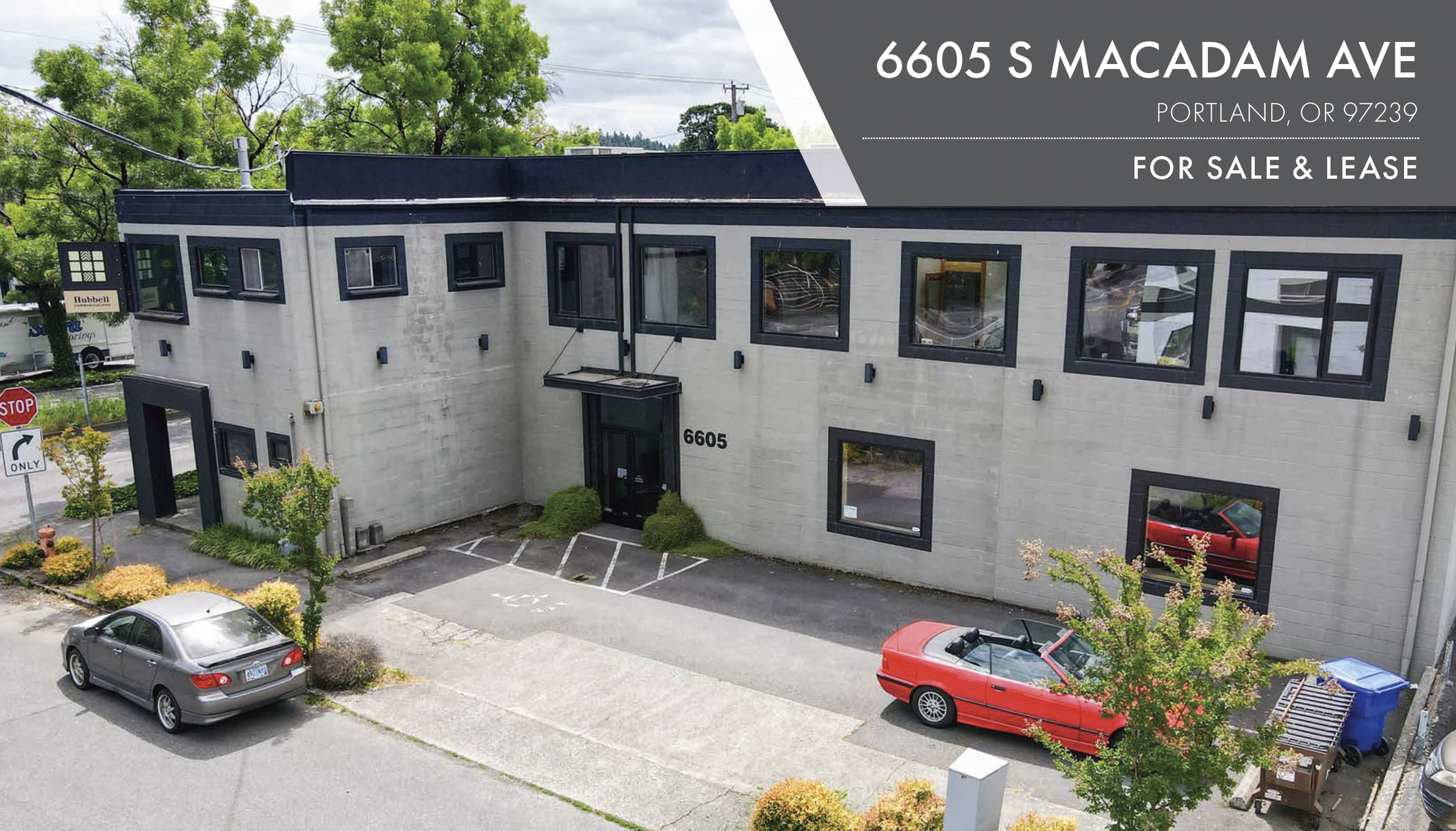
A 6,223-square-foot office building at 6605 S Macadam Ave in Portland's Johns Landing district is now 100% leased. Four suites, three tenants, three leases signed between February 2025 and October 2026 — in a metro office market that has posted record vacancy for most of that stretch, in a building with almost no on-site parking.
This case study covers how the lease-up came together: the building, the market it was competing in, the deal structure on each lease, and what it says about leasing small office buildings in Portland right now. Matt Lyman of Norris & Stevens represented the owner throughout.
Johns Landing Office Leasing FAQ
Q: What is 6605 S Macadam Ave in Portland?
A: A two-story, 6,223 RSF office building in Johns Landing, built in 1961 and renovated in 2017, zoned CM2, with four suites ranging from 1,069 to 1,900 SF. It was listed for sale and lease; the leasing campaign took it to 100% occupancy by October 2026.
Q: How long did it take to fully lease the Johns Landing office building?
A: About 20 months from the first signed lease (February 2025) to the last (October 2026). The largest tenant took 52% of the building in a single lease in November 2025.
Q: What do small office buildings in Johns Landing lease for?
A: The three leases at 6605 S Macadam landed between $17.00 and $21.00 per square foot per year, modified gross, on 36- to 43-month terms, against a $22.00 MG asking rate. Concessions included free rent and, on the largest suite, a reduced first-year rate.
Q: Is the Portland suburban office market better than downtown in 2026?
A: Yes. Downtown Portland office vacancy hit 34.7% at the end of 2025. Suburban submarkets are running in the 13% range, and buildings under roughly 10,000 SF are leasing faster than larger ones. Colliers specifically cited Johns Landing as one of the submarkets driving positive absorption in early 2026.
The Building: 6605 S Macadam Ave, Johns Landing
6605 S Macadam Ave sits on a 4,356 SF lot on S Macadam Ave, steps from Willamette Park and the river. Two floors, 6,223 rentable square feet, four suites: Suite 100 (1,382 SF) and Suite 101 (1,069 SF) on the first floor, Suite 200 (1,900 SF) and Suite 201 (1,325 SF) on the second. The 2017 renovation left it with updated common areas, kitchenettes, a shower, structured cabling, and access control.
The constraint was parking. On a lot that size there is room for a handful of spaces, not the 3 or 4 per 1,000 SF that suburban tenants expect. Every tour started with the same question, and every lease had to answer it.
The owner, an out-of-state private investor, engaged Norris & Stevens for landlord representation on a dual sale-and-lease listing: $1.9 million asking (later reduced to $1,695,000) or $22.00 per square foot modified gross. The strategy was to lease the building first. A fully leased small office building with three credit-worthy tenants on 3-plus-year terms is a far more saleable asset than a vacant one, and it produces income while the sale market recovers.
Portland Office Market Conditions During the Lease-Up
The timing was not kind. The metro office market hit a record 26.6% vacancy in Q3 2025 and roughly 27% by year-end, with downtown Portland office vacancy at 34.7%. Leasing volume for 2025 was the lowest on record.
But the market split in two. Suburban submarkets held vacancy in the 13% range through mid-2026 with positive absorption, driven by owner-users and small professional firms. Buildings around 10,000 SF and under recorded lower vacancy than larger properties. And in its Q1 2026 report, Colliers noted that move-ins outpaced move-outs in Portland for the first time since early 2020, "due in part to increased leasing in Johns Landing and Southeast Portland."
That is the market 6605 S Macadam was competing in: a close-in, non-downtown location with suburban-style demand but urban-style parking. The small-box office segment — suites under 10,000 SF for teams of 5 to 30 — is where the activity has been, and this building is four small-box suites stacked on top of each other.
Lease One: Suite 101, First-Floor Showroom and Office
The first lease signed in February 2025: an interior design firm took Suite 101, 1,069 SF, as an office and showroom. The tenant was represented by Colliers.
Terms: 39 months, April 2025 through June 2028. Base rent $1,870.75 per month — $21.00 per square foot annually, within a dollar of the $22.00 asking rate. The concession was three months of 100% rent abatement up front, with rent commencing July 2025. Annual escalations of roughly 3%. No parking allocated; the tenant's use was showroom and office with client visits by appointment, which made the parking constraint manageable.
A design showroom was a good fit for a ground-floor suite with Macadam frontage and natural light, and it brought foot traffic and a finished-looking space to a building that had been sitting empty. First tenants matter for that reason: they make the building feel occupied to everyone who tours after them.
Lease Two: Suites 200 and 201, the Anchor Deal
The second lease, signed November 2025, took the entire second floor: Suites 200 and 201 combined, 3,225 SF, 52% of the building. The tenant is an executive search and succession firm, represented by Apex Real Estate Partners.
Terms: 43 months, December 2025 through June 2029, modified gross. The deal structure addressed two things at once — a tenant moving in at the end of the year, and a landlord who wanted a long-term anchor on the upper floor rather than two more small leases.
Rent started at $3,008.33 per month through February 2027 — a reduced first-year rate of roughly $11.19 per square foot — then stepped to $5,259.44 (about $19.57 per square foot) in March 2027 with annual increases of 3% thereafter. Base rent commencement was March 1, 2026, so the first three months were free. The tenant also received two parking spaces, early access for two weeks before commencement, and use of existing furniture under an agreed inventory.
The economics: a steep first-year discount in exchange for a 43-month commitment on more than half the building, with the rate landing just under asking from month 16 onward. For an owner weighing a sale, that trade is worth it. The building's income profile for a buyer is defined by the stabilized rent, not the first year, and a 52% anchor with 3-plus years of term is what makes the asset financeable.
Lease Three: Suite 100 and 100% Occupancy
The last suite, Suite 100 at 1,382 SF on the ground floor, leased in October 2026 to a sales and marketing firm headquartered out of state and opening a Portland office. The tenant came without a broker.
Terms: 36 months, December 2026 through November 2029. Base rent $1,957.83 per month — $17.00 per square foot — with 3% annual escalations, use of the building's small storage room, and one reserved parking space at no additional charge. No free rent.
The rate was below the first two leases, which reflects where the market moved over the 20-month lease-up and the fact that this was the last suite in a building that was already three-quarters leased. At that point the owner's priority was certainty: a signed tenant, a full building, and a clean rent roll for the sale process. Holding out for another dollar per foot on 1,382 SF was not worth months of additional vacancy.
How the Parking Problem Was Solved
The building has fewer on-site spaces than tenants, so the spaces had to be allocated, not promised. Each lease spells out exactly what the tenant gets: two spaces for the anchor tenant, one reserved space for Suite 100, none for the showroom tenant whose clients arrive by appointment.
That specificity matters more than the count. Tenants who lose a deal over parking usually lose it because the answer was vague — "there's parking" — and the reality on day one was a fight over three spaces. Spelling the allocation out in the lease, and being direct about it on the first tour, screened for tenants who could live with it and eliminated the ones who could not before anyone spent money on a proposal.
The tenant mix did the rest. A showroom with appointment-based traffic, a recruiting firm, and a sales office are all low-parking-intensity uses. The building would not work for a medical practice or a high-headcount call center, and it was not marketed to them.
What This Johns Landing Lease-Up Shows About Portland Office Landlord Strategy
Four things carry beyond this building.
Lease before you sell. A vacant 6,223 SF office building in 2025 was a hard sale at any price. The same building with three tenants on 36- to 43-month terms and a stabilized rent roll in the $17–21 range is an investment, not a project. The sale-and-lease listing structure gave the owner both options, but the leasing is what created the value.
Concession structure beats rate cuts. Every lease here landed within $1–5 of the asking rate on stabilized rent. The flexibility went into free rent and, on the anchor, a discounted first year — concessions that cost the owner something up front but preserve the number a buyer underwrites to. Portland landlords competing on concession packages rather than headline rate are the ones filling space.
Right-size the tenant to the building's constraints. Three tenants in 20 months is not fast, but each one was the right tenant for a building with limited parking and small floor plates. The marketing targeted small professional firms and owner-operators, not the tenants the building could not serve.
Small-box office is a different market. Metro vacancy north of 25% describes downtown towers. It does not describe 1,000–3,000 SF suites in close-in neighborhoods with a Portland address, parking a client can actually find, and rents a small firm can carry. Those suites are leasing. Owners of buildings like this one should price and market them accordingly, not against the headline number.
Johns Landing and the Macadam Corridor for Office Tenants
Johns Landing runs along S Macadam Ave between downtown and Lake Oswego, with the Willamette River on one side and the Southwest hills on the other. It has historically been a mid-sized office submarket — buildings in the 10,000 to 50,000 SF range, a mix of professional services, medical, and nonprofit tenants, and consistently better parking ratios than downtown. Class A waterfront space on the corridor asks $30 to $37 per square foot; smaller Class B and C buildings like 6605 S Macadam trade in the high teens to low twenties.
For tenants, the corridor offers a downtown-adjacent address with a 10-minute drive to the CBD, access to I-5 via the Sellwood Bridge and Macadam, and a walkable strip of restaurants and services. For owners, it has been one of the few Portland office submarkets with positive absorption in 2026. The broader Portland submarket guide covers how Johns Landing compares to the 217 Corridor, Kruse Way, and the Central Eastside.
Leasing or Selling a Small Office Building in Portland
A small office building with vacancy is a pricing problem before it is a marketing problem. The right asking rate, the right concession structure, and an honest read on which tenants the building can actually serve determine whether it leases in months or sits for years.
If you own office space in Johns Landing or anywhere in the Portland metro and are deciding between leasing it up and selling it as-is, start with a lease rate analysis to see where the building sits against current comps, and a broker opinion of value on both the vacant and stabilized scenarios. The gap between those two numbers is usually the argument for leasing first.